Outsourced Intelligence

We humans have something quite unique about us: we can outsource our intelligence. Let that sink in for a moment before you read further. Take a pause and think about what that actually means.
We have the option to outsource our intelligence to other agents; not just AI, but our peers, teams, consultants, institutions, and experts. If I don't know something, I can find someone who does. If I don't have the time to figure something out, I can pay someone who already knows how to do it. If I don't want to spend the mental energy on a particular problem, I can simply ask someone else to solve it for me. So what does that mean for us?
I have been paying taxes since the day I joined the corporate world. In my first tax-filing season, I didn't understand any of it. I was basically like, what am I supposed to do with all of this? I had two options: either learn about all the taxation laws relevant to a salaried employee, or simply hire an accountant who could file my taxes for me and, in return, I would pay them. Simple.
So what did I do?
In the first year, I paid the accountant.
Over the next year, however, I gradually started learning the nuances of taxation,at least the ones that concerned me. In my second tax-filing season, I would sit with the accountant and she would guide me through the process, but this time I had some context. I knew things I didn't know the previous year. I could ask better questions. I could understand why certain things were being done instead of simply accepting that they were being done.
The learning continued.
By my third tax-filing season, I filed everything myself. I had reached a point where I understood enough to do it on my own.
Now think about the time difference here. It took me roughly two years of learning, asking questions, making sense of things and gradually building knowledge. The accountant I consulted could probably look at my specific case and file it within a few minutes.
So essentially, I was exchanging money and trust for someone else's knowledge and experience. I was using Outsourced Intelligence.
Does that make me dumb?
Of course not.
Maybe I was simply compressing time.
Instead of spending weeks, months or even years learning everything myself, I could pay someone who had already spent those years learning it. That is one of the fundamental reasons specialization works. I don't need to become an expert in everything.
And I am in no way suggesting that we shouldn't seek expert advice. We absolutely should. There are things where it makes far more sense to rely on someone who has spent years developing expertise.
But there is something else I learned from this experience: there is value in knowing enough to understand what you are outsourcing.
I didn't need to become a tax expert. But learning enough meant I could understand what my accountant was doing, ask questions, catch things that didn't make sense and eventually take the responsibility back myself.
That distinction becomes important when we talk about Outsourced Intelligence.
When I say Outsourced Intelligence, or OI, I don't necessarily mean artificial intelligence. OI can be any intelligence that we choose to access or delegate to outside ourselves. An accountant, a consultant, a colleague, a team, an institution, an expert, or an AI system can all become sources of Outsourced Intelligence.
AI is simply making OI cheaper, faster and more accessible than it has ever been.
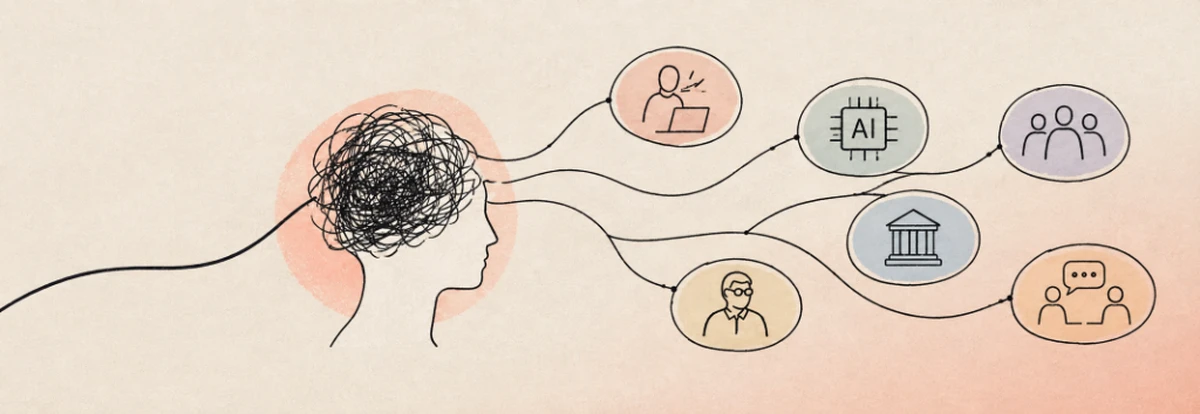
Traditionally, using Outsourced Intelligence came with friction. You had to find the right person. You had to pay them. You had to explain your problem. You had to wait. And, perhaps most importantly, you had to trust them.
At least for me, even after paying an expert, I would still probably cross-check whatever they told me.
That friction is now disappearing.
Outsourcing intelligence has become cheaper, faster and increasingly accessible. You can ask a system what you should wear, help you make a financial decision, summarize a document, write an email, analyze a contract or even help you navigate a relationship. The list goes on.
And the interesting part isn't simply that AI can do these things. The interesting part is that we are becoming increasingly comfortable with not doing these things ourselves.
The basic question that keeps coming to my mind is: if this continues for a long enough period of time, what happens to us as humans?
We might become increasingly dependent on Outsourced Intelligence. And the scary part isn't necessarily that the intelligence we outsource will be wrong. It might often be better than ours.
The scary part is that we may eventually lose enough judgment in certain areas that we are no longer capable of deciding whether it is right or wrong.
That, to me, would be the real collapse of the phrase "use your brain."
Imagine a future where almost everyone has access to a centralized layer of Outsourced Intelligence that can answer questions, make recommendations, generate ideas and solve problems. The intelligence is available to everyone, almost instantly, and perhaps at almost no cost.
What happens to individual judgment in that world?
What happens to expertise?
What happens to the things we currently spend years learning?
There is a very simple example of this that we are already seeing today.
Imagine you are writing an email to sell your product. You ask AI to make it as persuasive and polished as possible. It writes a beautiful email for you. You send it to me.
I receive it, hit the "summarize" button, read three bullet points, and move on.
Your beautifully crafted email, which may have taken seconds to generate, is now reduced to a few lines of Outsourced Intelligence on my side. And if I need to respond, I might ask AI to write that response for me too.
You can see how the loop begins.
I outsource my intelligence to AI. You outsource yours to AI. I respond to your AI-generated message using AI-generated intelligence, and you do the same on your side.
At some point, we might find ourselves communicating through layers of Outsourced Intelligence that neither of us actually generated.
And this isn't necessarily a problem today. In fact, it is incredibly useful.
The question is where this trajectory takes us.
Will this eventually lead to some kind of collapse of human civilization?
Honestly, that feels far-fetched to me. I don't think we can confidently make that prediction.
But I do think we need new ways of thinking about how we use our own intelligence when access to Outsourced Intelligence becomes cheap, easy and almost always available.
I am already experiencing a very small version of this myself.
I no longer need to spend two hours proofreading an article. I can outsource that task and get it done in a minute, with probably better accuracy than I would have achieved myself. And as of now, it costs me almost nothing.
Until Sam Altman starts asking me for money, haha.
But perhaps proofreading isn't the interesting part.
The interesting part begins when I move one step backward.
Today, I might write an article myself and then ask AI to proofread it. I still did the thinking. I researched the topic, formed my arguments, struggled with the words and eventually put my thoughts together. AI simply helped me polish the output.
But what happens when I ask AI to write the article itself?
That is where I think things start getting interesting.
Initially, I might feel a little guilty about it. Eventually, I might stop feeling guilty altogether. Writing from scratch takes time. It requires effort. It requires me to exercise my brain.
And if an AI can produce something that looks better in a fraction of the time, why would I continue doing it the hard way?
This is where I wonder whether we might slowly start outsourcing not just the output, but the process through which we develop our intelligence.
Writing is a good example because I genuinely enjoy the process.
Suppose I want to write about something like the difference between the energy consumption of the human brain and artificial computation. I could simply type a prompt and ask an AI to write a fantastic article about it.
And it probably would.
But would I enjoy that article in the same way?
Or would I rather spend hours reading different articles, going through blogs written by people who think similarly to me, finding a particular paragraph that makes me stop and think, highlighting it, saving it somewhere, opening a raw text editor and throwing all of these fragmented thoughts into one place?
Then I would start writing.
I would probably write multiple versions. I might send a draft to a friend. They might disagree with something. I might defend my argument, or realize that they are right and change it. I might discover a completely different perspective halfway through the process.
Eventually, I would publish something that still has mistakes, unfinished hypotheses and perhaps even ideas that only make sense to me because I have built a particular pattern of thinking around them.
And that's exactly what makes it mine.
The final article is only the visible artifact of all of that invisible work.
If you observe closely, the dopamine isn't necessarily coming from having a perfectly polished article sitting in front of you. A lot of it comes from the process: discovering something new, connecting two ideas, finding a pattern, writing something that finally makes sense, receiving criticism, defending an argument, changing your mind and eventually sharing what you have created.
The process is the reward.
And I think this applies to far more than writing.
We are going to use Outsourced Intelligence for all kinds of things. We will ask it to help us make decisions, research topics, learn new skills, write code, plan trips, negotiate, communicate and perhaps even decide what we should do with our lives.
There is nothing inherently wrong with any of that.
But at what point does assistance become replacement?
At what point does convenience become dependency?
And at what point do we stop exercising a particular part of our intelligence simply because there is no longer any reason to?
This is where I become curious about the future.
What happens to our curiosity when every question can be answered immediately? What happens when we don't need to go down the rabbit hole ourselves because we can simply ask an AI to summarize the rabbit hole for us?
What happens when we stop being experts in certain areas because there is always an intelligence available that knows more than we do?
And perhaps most importantly, what will we be proud of?
If AI can write better than me, calculate better than me, research faster than me, code faster than me and potentially make better decisions than me, what exactly remains uniquely mine?
Maybe the answer is not that we should stop using Outsourced Intelligence.
Maybe the answer is that we need to become much more deliberate about what we choose to outsource.
There is a difference between asking AI to proofread something I wrote and asking AI to think about something I never thought about.
There is a difference between using AI to challenge my reasoning and using AI to give me a conclusion.
There is a difference between using AI as a cognitive partner and using it as a replacement for cognition.
And perhaps that distinction will become one of the most important skills of the next decade.
Historically, our intelligence has been one of the reasons humans have been able to dominate almost every environment on Earth. Our ability to build institutions, accumulate knowledge across generations, develop technologies and coordinate at enormous scale has given us an extraordinary advantage.
But what happens when intelligence itself becomes abundant?
What happens when almost everyone has access to an external source of Outsourced Intelligence that can perform at a level beyond any individual human in many domains?
Does intelligence still remain our competitive advantage?
Or does the advantage shift toward something else?
This is where my thoughts become more speculative.
Two years ago, I read a book by Nick Bostrom, Superintelligence, in which he explores different ways in which machine intelligence could eventually surpass human intelligence. One thing I personally take away from that broader discussion is that the problem isn't simply whether something becomes more intelligent than us. The combination of intelligence with speed, scale and autonomy is what makes the scenario particularly difficult to reason about.
A human can only process so much information.
A sufficiently capable artificial system could potentially process vastly more.
A human can influence a limited number of people at a time.
A digital system can potentially influence millions. We have already seen some form of it through the use of social media apps, and just to put this into perspective, AI applications like ChatGPT, Claude and Gemini are being used by billions of people.
And if we become deeply dependent on Outsourced Intelligence while simultaneously losing our ability to independently evaluate it, we could create a very strange vulnerability.
We might not need to be forced.
We might simply be persuaded.
We might trust the system because it has been right so many times before.
And perhaps that is where the real danger lies—not in an intelligence that suddenly takes control, but in humans gradually surrendering their ability to question the intelligence they depend on.
Of course, this is still speculative. The idea of a superintelligent system manipulating humanity sounds like the plot of a Hollywood movie. But the underlying direction is not imaginary. AI systems are becoming more capable, more autonomous and more deeply integrated into the way we work and communicate. The infrastructure required to train and run them is growing rapidly as well.
I don't know where this leads.
Maybe AI will make us dramatically more capable. Maybe it will free us from meaningless cognitive work and give us more time to explore, create and think about things that actually matter.
Or maybe we will gradually become dependent on systems that do more and more of the thinking for us.
Perhaps both things will happen at the same time.
Our intelligence might be perfectly safe today. I just don't know what happens when the intelligence we outsource becomes significantly better, faster and more pervasive than our own.
And that brings me back to the original question.
If intelligence becomes something we can outsource almost completely, what happens to the human need to think?
Maybe the future isn't about whether AI is smarter than us.
Maybe the real question is whether we will continue to use our own intelligence when we no longer have to.
Because perhaps the greatest risk of Outsourced Intelligence isn't that we will become less intelligent overnight.
Perhaps it is that we will become so comfortable letting something else think for us that, slowly and quietly, we will forget why we ever needed to think for ourselves.